


You Don’t Need a Better Algorithm. You Need More Domain Knowledge.
We’ve all been there. You’ve spent weeks cleaning a messy dataset, you’ve tuned your machine learning model to perfection, and the metrics look fantastic. But when you present your findings to the leadership team, it lands with a thud. They glance at your perfectly formatted charts and say, "This doesn't make any sense for our reality."
What went wrong? The math was right. The code was clean. But the project failed because it lacked the most important variable in data science: domain knowledge.
In our rush to master the latest Python libraries, complex econometric models, or statistical software, it’s incredibly easy to treat data as just numbers in a vacuum. But data is never just numbers. It’s a proxy for human behavior, market realities, and real-world events. Without a deep understanding of the specific field you are analyzing the business context even the best data strategy is just guesswork.
Why Context Beats CodeAlgorithms are amazing at finding patterns, but they are completely blind to meaning. They can’t tell the difference between a critical business threat and a basic data entry error. That’s your job.
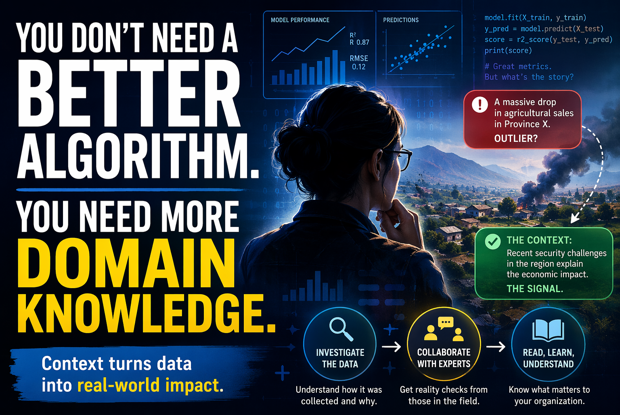
Let’s look at a practical example. Imagine you are working with a General Household Survey dataset, analyzing economic trends in specific regions. Your model suddenly flags a massive, sharp drop in agricultural sales and market activity in one specific province.
If you are just looking at the numbers, you might interpret this as a seasonal supply chain glitch. You might even treat it as an outlier and clean it out of your dataset so it doesn't skew your broader regression model.
But if you have domain knowledge regarding regional socio-economics, your interpretation changes completely. You know the local context. You realize that this sudden drop correlates exactly with recent localized security challenges in that specific conflict-affected area. The drop isn't an anomaly to be smoothed over it is the single most important signal in the entire dataset. It represents the actual economic impact of insecurity.
Without that context, you deliver a model that is mathematically flawless but practically useless. With that context, you deliver actionable insights that can actually drive policy or business intervention.
Bridging the GapSo, how do you stop just crunching numbers and start actually solving problems? You have to step away from the keyboard and get into the weeds of the subject matter.
1. Become an investigator, not just an analyst. Never accept a dataset at face value. Before you write a single line of code, figure out exactly how the data was collected. Talk to the people on the ground gathering it. Understand the biases, the collection flaws, and the historical quirks baked into those specific columns.
2. Treat Subject Matter Experts (SMEs) as your co-pilots. You shouldn't be working in a silo. If you are analyzing educational data, you need to be talking to teachers and curriculum developers. If you are analyzing financial data, talk to the accountants. Run your early, messy hypotheses past them. Ask, "Does this trend actually match what you see happening in the real world?"
3. Read the room (and the literature). You can't provide value if you don't know what matters to the organization. What are the key performance indicators that actually keep the leadership team awake at night? Read the industry reports. Understand the baseline theories of the field you are analyzing so you know what a "normal" baseline looks like.
The Real DifferentiatorAs tools get easier to use and algorithms become more automated, simply knowing how to build a model is no longer a unique skill. The technical execution is becoming commoditized.
What can't be automated is the human ability to connect raw data to a nuanced, messy, real-world context. For any data professional who wants to actually drive decisions and see their work implemented, domain knowledge isn't a "nice-to-have" soft skill. It is the core foundation of the job. Focus on the context, and the actionable insights will follow.